

 Home
Home
1. Why this matters for MRCGP
- This is an AKT favourite because a few numbers and medicine rules completely change the answer: HbA1c targets, folic acid dose, retinal and renal assessment, and medicines to stop before pregnancy.
- It is an SCA favourite because the consultation is often a “planning pregnancy” or “positive pregnancy test” scenario where the GP must reduce risk without frightening or blaming the patient.
- The key GP risk is treating this like routine type 2 diabetes. Pregnancy changes glucose monitoring, urgency, medicines, referral and safety-netting.
- Practical use matters because the GP may need to prescribe folic acid 5 mg, review unsafe medicines, arrange retinal and renal checks, and escalate urgently if the patient is pregnant and unwell.
2. GP Bottom Line
- Recognise the situation early: anyone with pre-existing type 2 diabetes who may become pregnant needs planned preconception care, not routine diabetes review alone.
- Urgency changes if pregnant and unwell: hyperglycaemia or being unwell in pregnancy needs urgent medical advice and ketone assessment; suspected diabetic ketoacidosis needs immediate hospital admission for level 2 critical care.
- Usual GP action: optimise before conception, advise contraception until good glucose control, prescribe folic acid 5 mg daily until 12 weeks, arrange retinal and renal assessment, and link with diabetes/antenatal care.
- Key trap: continuing the usual non-pregnancy type 2 diabetes drug pathway. In pregnancy planning, metformin may be used, but other oral glucose-lowering agents should be stopped before pregnancy and insulin used instead.
- Do not stop the medicines review at tablets: ask about non-insulin injectable diabetes or weight-loss medicines, including GLP-1 receptor agonists and tirzepatide, including private prescriptions. Effective contraception is needed while taking GLP-1 receptor agonists or tirzepatide. Semaglutide should be stopped at least 2 months before planned pregnancy and tirzepatide at least 1 month before planned pregnancy. If pregnancy is already confirmed while taking one of these medicines, arrange urgent joint diabetes/antenatal medication review.
3. 60 Second Exam Snapshot
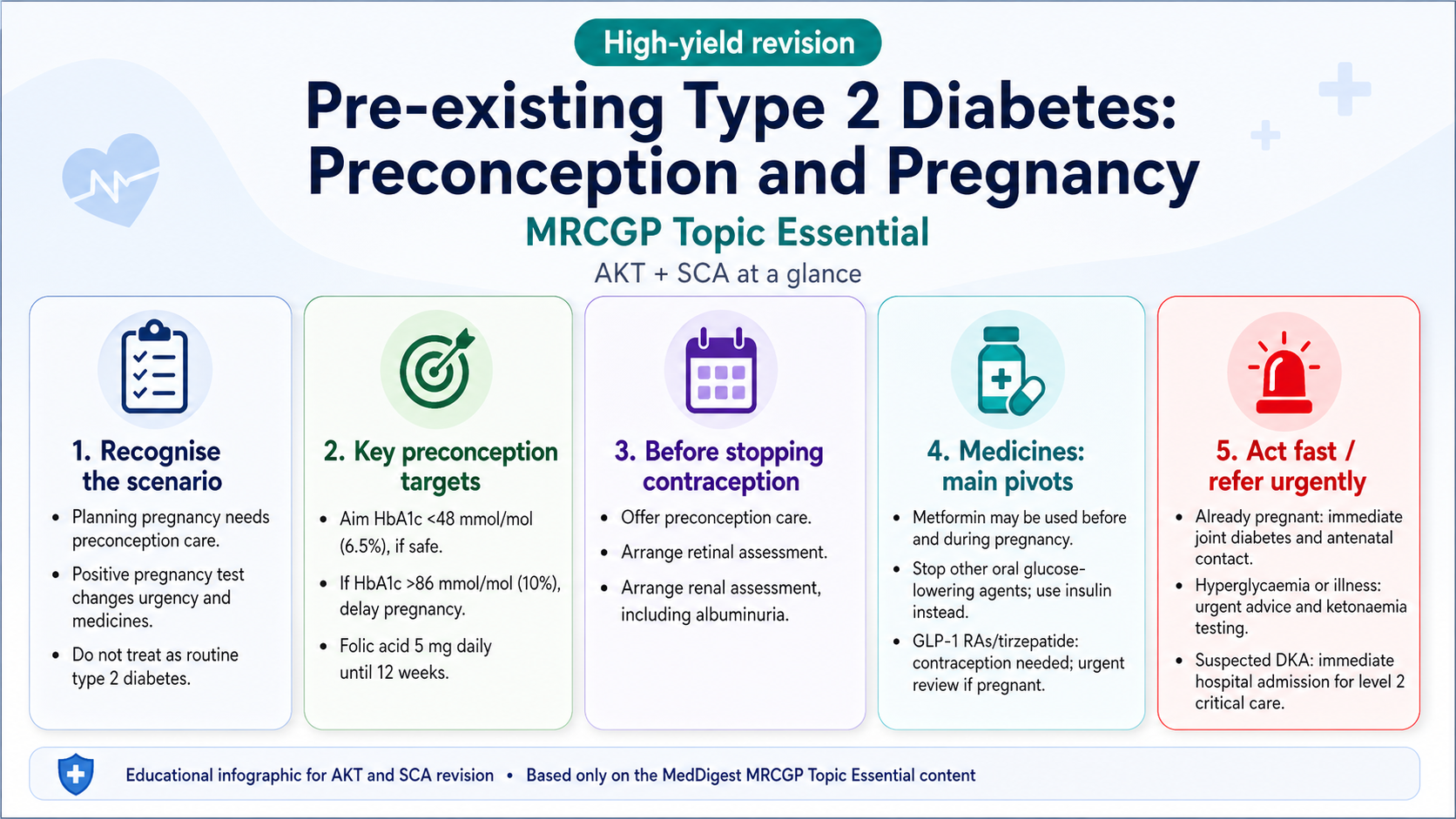
- Preconception HbA1c target: below 48 mmol/mol (6.5%), if achievable without problematic hypoglycaemia.
- If HbA1c is above 86 mmol/mol (10%), strongly advise not trying for pregnancy until it is lower.
- Offer up to monthly HbA1c before pregnancy and offer blood glucose meters for self-monitoring.
- Prescribe folic acid 5 mg daily until 12 weeks’ gestation.
- Before stopping contraception: arrange retinal assessment and renal assessment including albuminuria.
- Stop ACE inhibitors and angiotensin-II receptor antagonists before conception, or as soon as pregnancy is confirmed.
- For statins: stop 3 months before attempting conception. If pregnancy is already confirmed and the statin has not already been stopped, stop it as soon as pregnancy is confirmed. Do not restart statins until breastfeeding has finished.
- Already pregnant with type 2 diabetes: arrange immediate contact with a joint diabetes and antenatal clinic.
- Birth timing and setting are planned by the joint diabetes and antenatal/obstetric team. For exam purposes, be aware that uncomplicated pre-existing type 1 or type 2 diabetes is usually planned for elective birth by induced labour, or caesarean section if indicated, between 37+0 and 38+6 weeks; Earlier birth may be considered if there are metabolic, maternal or fetal complications. Birth should be in a hospital with 24 hour advanced neonatal resuscitation skills.
4. Recognition and Diagnosis
The “diagnosis” here is usually already known: pre-existing type 2 diabetes, not gestational diabetes. The GP task is to recognise the pregnancy risk window.
Key situations:
- Known type 2 diabetes and planning pregnancy.
- Known type 2 diabetes and not using contraception.
- Positive pregnancy test while taking diabetes, blood pressure or lipid medicines.
- Pregnant patient with type 2 diabetes who is hyperglycaemic, vomiting, dehydrated, drowsy, confused or otherwise unwell.
- Existing diabetic retinopathy or kidney disease before pregnancy.
Note: Do not use HbA1c to diagnose diabetes in pregnant women or women within 2 months postpartum. In this topic, HbA1c is mainly used for preconception risk reduction and risk assessment at booking, not as a second/third trimester day-to-day glucose control tool.
5. AKT Essentials: What Changes the Answer
Diagnosis / recognition
- Pre-existing type 2 diabetes in pregnancy is high risk and needs joint diabetes/antenatal care.
- If a child or adolescent has diabetes, do not assume adult style type 2 diabetes management; that is a separate specialist pathway.
Investigation / interpretation
- Before pregnancy: offer HbA1c up to monthly.
- Aim for HbA1c below 48 mmol/mol (6.5%) if safe.
- HbA1c above 86 mmol/mol (10%): strongly advise against pregnancy until lower.
- At booking: measure HbA1c to determine pregnancy risk.
- Do not routinely use HbA1c to assess glucose control in the second and third trimesters.
Management / next best step
- Advise contraception until good blood glucose control is achieved.
- Offer preconception care before stopping contraception.
- Prescribe folic acid 5 mg/day until 12 weeks’ gestation.
- If already pregnant, arrange immediate contact with the joint diabetes and antenatal clinic.
- Preconception: defer rapid optimisation of blood glucose control until retinal assessment and any needed treatment have been completed. Once pregnancy is already established: diabetic retinopathy should not be treated as a contraindication to rapid optimisation if HbA1c is high; manage urgently with the joint diabetes and antenatal team and follow the pregnancy retinal assessment pathway.
Referral / urgency
- Pregnant and hyperglycaemic or unwell: urgent medical advice and urgent ketonaemia testing.
- Suspected diabetic ketoacidosis: immediate hospital admission for level 2 critical care with medical and obstetric care.
- Joint diabetes and antenatal clinics should be in contact every 1–2 weeks throughout pregnancy.
Medicines / safety
- Metformin may be advised as an adjunct or alternative to insulin before conception and during pregnancy when benefits from improved glucose control outweigh potential harm.
- Stop all other oral glucose lowering agents before pregnancy and use insulin instead.
- Do not stop the medicines review at tablets: ask about non-insulin injectable diabetes or weight loss medicines, including GLP-1 receptor agonists and tirzepatide, including private prescriptions. Effective contraception is needed while taking GLP-1 receptor agonists or tirzepatide. Semaglutide should be stopped at least 2 months before planned pregnancy and tirzepatide at least 1 month before planned pregnancy. If pregnancy is already confirmed while taking one of these medicines, arrange urgent joint diabetes/antenatal medication review.
- Stop ACE inhibitors and angiotensin-II receptor antagonists before conception or as soon as pregnancy is confirmed.
- For statins: stop 3 months before attempting conception. If pregnancy is already confirmed and the statin has not already been stopped, stop it as soon as pregnancy is confirmed. Do not restart statins until breastfeeding has finished.
- In pregnancy care, the rapid-acting insulin analogues insulin aspart and insulin lispro are supported options for specialist-led treatment.
- First-choice long-acting insulin in pregnancy is isophane insulin, also known as NPH insulin.
- Long-acting insulin analogues insulin detemir or insulin glargine may be continued if good control was established before pregnancy.
Follow-up / monitoring
- Pregnancy capillary plasma glucose targets, if achievable without problematic hypoglycaemia: fasting below 5.3 mmol/L, 1 hour post-meal below 7.8 mmol/L, or 2 hour post-meal below 6.4 mmol/L.
- Pregnant women taking insulin should keep capillary plasma glucose above 4 mmol/L.
- Birth timing and setting are planned by the joint diabetes and antenatal/obstetric team.
- Uncomplicated pre-existing type 1 or type 2 diabetes is usually planned for elective birth by induced labour, or caesarean section if indicated, between 37+0 and 38+6 weeks; Earlier birth may be considered if there are metabolic, maternal or fetal complications. Birth should be in a hospital with 24 hour advanced neonatal resuscitation skills.
- Labour: monitor capillary plasma glucose hourly and maintain 4–7 mmol/L.
6. SCA Consultation Essentials
Likely SCA task: a woman with type 2 diabetes asks about pregnancy, has stopped contraception, or has a positive pregnancy test while on diabetes and cardiovascular medicines.
Ask specifically:
- “Are you planning pregnancy now, or could you already be pregnant?”
- Current contraception and whether she has stopped it.
- Recent HbA1c and home glucose readings, if available.
- Current medicines: metformin, insulin, other oral diabetes medicines, sodium-glucose co-transporter 2 inhibitors, GLP-1 receptor agonists, tirzepatide, blood pressure medicines and statins.
- Non-insulin injectable diabetes or weight-loss medicines, including private prescriptions. Effective contraception is needed while taking GLP-1 receptor agonists or tirzepatide; semaglutide should be stopped at least 2 months before planned pregnancy and tirzepatide at least 1 month before planned pregnancy.
- Retinal screening, kidney tests and known complications.
- Hypoglycaemia, impaired awareness of hypoglycaemia, vomiting, dehydration, high glucose or feeling unwell.
Communication pivot:
- Explain that good glucose control reduces risks of miscarriage, congenital malformation, stillbirth and neonatal death, but does not remove them completely.
- Keep the wording practical: “This is about planning safely, not saying you cannot have a pregnancy.”
- Make the immediate plan explicit: contraception until optimised if not pregnant; urgent joint clinic contact if pregnant.
Specific safety-net:
- “If you are pregnant and become unwell or your glucose is high, this is not a routine diabetes query — seek urgent medical advice the same day.”
7. Red Flags / Escalation / Referral
Emergency escalation
- Arrange immediate hospital admission if diabetic ketoacidosis is suspected in pregnancy.
- Features that should raise concern include hyperglycaemia with symptoms such as polydipsia, polyuria, weight loss, abdominal pain, nausea or vomiting, shortness of breath, lethargy, drowsiness, confusion, dehydration, shock, acetone smell on the breath or deep sighing breathing.
Urgent same-day action
- A pregnant woman with type 2 diabetes who is hyperglycaemic or unwell needs urgent medical advice and urgent testing for ketonaemia.
Specialist pathway
- Already pregnant with diabetes: immediate contact with a joint diabetes and antenatal clinic.
- Preconception: offer preconception care before stopping contraception.
- Renal thresholds before stopping contraception: consider nephrology referral if serum creatinine is 120 micromol/L or more, urinary albumin:creatinine ratio is greater than 30 mg/mmol, or estimated glomerular filtration rate (eGFR) is less than 45 mL/minute/1.73 m².
- During pregnancy: consider nephrology referral if serum creatinine is 120 micromol/L or more, urinary albumin:creatinine ratio is greater than 30 mg/mmol, or total protein excretion exceeds 0.5 g/day.
- Do not use eGFR to measure kidney function in pregnant women.
8. What the GP Should Do Today
Assess
- Check pregnancy status, pregnancy plans, contraception, HbA1c, home glucose monitoring, current medicines, diabetic eye and kidney history, hypoglycaemia risk, and whether she is currently unwell.
- Ask specifically about non-insulin injectable diabetes or weight-loss medicines, including private prescriptions.
Investigate / arrange
- Before pregnancy:
- HbA1c, up to monthly.
- Retinal assessment at the first preconception appointment unless done in the last 6 months.
- Renal assessment including albuminuria before stopping contraception.
- If already pregnant:
- HbA1c at booking.
- Retinal assessment after first antenatal clinic appointment unless done in the last 3 months.
- Renal assessment at first contact if not done in the last 3 months.
Treat / advise
- Advise contraception until good glucose control.
- Prescribe folic acid 5 mg daily until 12 weeks.
- Offer individualised dietary advice.
- If body mass index is above 27 kg/m² and pregnancy is being planned, offer advice on weight loss.
- Review medicines that need stopping or specialist replacement, including oral glucose lowering agents, non-insulin injectable diabetes or weight-loss medicines, ACE inhibitors, angiotensin-II receptor antagonists and statins.
- For insulin treated pregnancy, explain the risk of hypoglycaemia and impaired awareness, and advise the patient to always have a fast-acting form of glucose available.
Refer / escalate
- Preconception diabetes care before stopping contraception.
- Immediate joint diabetes and antenatal clinic contact if pregnant.
- Emergency admission if diabetic ketoacidosis is suspected.
Review
- Preconception HbA1c up to monthly.
- Pregnancy diabetes/antenatal contact every 1–2 weeks.
- Postnatal: refer back to routine diabetes care and remind about contraception and preconception care for future pregnancies.
9. Practical Use in GP: How to Apply This Topic
Before conception
- Ask about pregnancy plans at diabetes reviews.
- Advise contraception until HbA1c is optimised.
- Explain the HbA1c target and the high risk threshold.
- Prescribe folic acid 5 mg daily.
- Arrange retinal and renal assessment before contraception is stopped.
- Review medicines before pregnancy, not after the patient has already conceived.
- Do not stop the medicines review at tablets: ask about GLP-1 receptor agonists, tirzepatide and private prescriptions.
- For statins, stop 3 months before attempting conception.
If pregnancy is confirmed
- Arrange immediate joint diabetes and antenatal clinic contact.
- Review medicines urgently.
- Arrange retinal and renal assessment if not recently done.
- Explain urgent action for hyperglycaemia or illness.
- If pregnancy is already confirmed while taking a GLP-1 receptor agonist or tirzepatide, arrange urgent joint diabetes/antenatal medication review.
Patient monitoring
- If diet/oral therapy/single-dose intermediate or long-acting insulin: fasting and 1 hour post-meal glucose daily.
- If multiple daily insulin injections: fasting, pre-meal, 1 hour post-meal and bedtime glucose daily.
- Targets should be individualised and balanced against hypoglycaemia risk.
What not to do
- Do not intensify routine non-pregnancy type 2 diabetes medicines as though pregnancy makes no difference.
- Preconception: defer rapid optimisation of blood glucose control until retinal assessment and any needed treatment have been completed. Once pregnancy is already established: diabetic retinopathy should not be treated as a contraindication to rapid optimisation if HbA1c is high; manage urgently with the joint diabetes and antenatal team and follow the pregnancy retinal assessment pathway.
- Insulin dose changes, ketone-testing technique and glucose monitoring technique should be managed through the joint diabetes/antenatal team and local pathway; do not add unsupported operational instructions.
10. Medicines, Investigations and Intervention Safety
Metformin
- Metformin may be used before conception and during pregnancy as an adjunct or alternative to insulin when likely benefits outweigh potential harm.
- For non-pregnant preconception review or postnatal metformin prescribing, follow the supplied renal-function safety advice: check renal function before treatment, review the dose if eGFR is less than 45 mL/min/1.73 m², and do not start or continue metformin if eGFR is less than 30 mL/min/1.73 m².
- During pregnancy, do not use eGFR to assess kidney function; arrange pregnancy renal assessment and consider nephrology referral using the supplied serum creatinine, albumin:creatinine ratio and proteinuria thresholds, with joint diabetes/antenatal input on medicines.
- Metformin can reduce vitamin B12 levels; test if deficiency is suspected and consider periodic monitoring in those with risk factors.
Other glucose lowering medicines
- Stop all other oral glucose lowering agents before pregnancy and use insulin instead.
- Sodium-glucose co-transporter 2 inhibitors include supplied examples such as dapagliflozin and empagliflozin. These medicines are associated with diabetic ketoacidosis, including atypical presentations with only moderately raised glucose. Prescribing information for dapagliflozin and empagliflozin advises avoiding these medicines in pregnancy and breastfeeding.
- GLP-1 receptor agonists include supplied examples such as liraglutide, dulaglutide and semaglutide. Tirzepatide is described as a dual glucose-dependent insulinotropic polypeptide and glucagon-like peptide-1 receptor agonist.
- Effective contraception is needed while taking GLP-1 receptor agonists or tirzepatide. Semaglutide should be stopped at least 2 months before planned pregnancy and tirzepatide at least 1 month before planned pregnancy. If pregnancy is already confirmed while taking one of these medicines, arrange urgent joint diabetes/antenatal medication review.
- Tirzepatide may reduce oral contraceptive reliability after starting and after dose escalation in people who are overweight or obese; the supplied source advises switching to a non-oral method or adding a barrier method for 4 weeks.
Insulin
- Pregnancy insulin regimen changes should be managed with the diabetes/antenatal team. Rapid-acting insulin analogues aspart and lispro have not been shown to have an adverse effect on pregnancy or the baby. Isophane insulin, also called NPH insulin, is first choice long-acting insulin in pregnancy. Insulin detemir or insulin glargine may be continued if good blood glucose control was established before pregnancy.
- For insulin-treated pregnancy, explain the risk of hypoglycaemia and impaired awareness, and advise the patient to always have a fast-acting form of glucose available.
- After birth, women with insulin treated pre-existing diabetes should reduce insulin immediately and monitor glucose to find the appropriate dose; explain that hypoglycaemia risk is increased postnatally, especially when breastfeeding, and advise having a meal or snack available before or during feeds.
Retinal assessment
- Before pregnancy: offer retinal assessment at the first preconception appointment unless done in the previous 6 months. Preconception: defer rapid optimisation of blood glucose control until retinal assessment and any needed treatment have been completed.
- Once pregnancy is already established: diabetic retinopathy should not be treated as a contraindication to rapid optimisation if HbA1c is high; manage urgently with the joint diabetes and antenatal team and follow the pregnancy retinal assessment pathway.
- During pregnancy: offer retinal assessment after the first antenatal clinic appointment unless done in the previous 3 months. If retinopathy is present, offer another assessment at 16–20 weeks, and offer retinal assessment again at 28 weeks.
Renal assessment
- Before stopping contraception: assess renal function including albuminuria.
- During pregnancy: arrange renal assessment at first contact if not done in the previous 3 months.
- Do not use eGFR to measure kidney function in pregnancy.
- Consider nephrology referral before stopping contraception if serum creatinine is 120 micromol/L or more, urinary albumin:creatinine ratio is greater than 30 mg/mmol, or eGFR is less than 45 mL/minute/1.73 m².
- During pregnancy, consider nephrology referral if serum creatinine is 120 micromol/L or more, urinary albumin:creatinine ratio is greater than 30 mg/mmol, or total protein excretion exceeds 0.5 g/day.
Labour and baby
- Birth timing and setting are planned by the joint diabetes and antenatal/obstetric team. Uncomplicated pre-existing type 1 or type 2 diabetes is usually planned for elective birth by induced labour, or caesarean section if indicated, between 37+0 and 38+6 weeks; earlier birth may be considered if there are metabolic, maternal or fetal complications. Birth should be in a hospital with 24 hour advanced neonatal resuscitation skills.
- During labour and birth, capillary plasma glucose should be checked hourly and maintained between 4 and 7 mmol/L. Use intravenous dextrose and insulin if this is not maintained.
- After birth, babies of women with diabetes should be fed within 30 minutes and then every 2–3 hours until feeding maintains pre-feed capillary plasma glucose at a minimum of 2.0 mmol/L. Routine baby glucose testing is at 2–4 hours after birth.
Postnatal and breastfeeding medicine safety
- While breastfeeding after pre-existing type 2 diabetes, metformin may be resumed or continued immediately after birth; this is off-label. Avoid other oral blood glucose-lowering therapy while breastfeeding.
- Continue to avoid medicines for diabetes complications that were stopped for pregnancy safety reasons; statins should not be restarted until breastfeeding has finished, and ACE inhibitors or angiotensin-II receptor antagonists should not be used in breastfeeding unless absolutely necessary after risk benefit discussion.
11. How to Explain It to the Patient
- “Planning pregnancy with type 2 diabetes is about reducing risk as much as possible before conception.”
- “The target before pregnancy is an HbA1c below 48 mmol/mol if we can get there safely without troublesome low sugars.”
- “If your HbA1c is above 86 mmol/mol, the advice is not to try for pregnancy until it is lower, because the risks are higher.”
- “Please keep using contraception until the diabetes team has helped you prepare safely.”
- “You should take folic acid 5 mg every day until 12 weeks of pregnancy.”
- “If you use diabetes or weight loss injections privately or through another service, please tell the diabetes team because some medicines need stopping before pregnancy.”
- “If you are pregnant and become unwell or your glucose is high, seek urgent medical advice because ketones need to be checked.”
12. When the Plan Changes
- If: HbA1c is above 86 mmol/mol.
- Why this changes the plan: pregnancy risk is higher.
- What the GP does now: strongly advise not trying for pregnancy until HbA1c is lower, continue contraception, and arrange diabetes/preconception support.
- If: pregnancy is already confirmed.
- Why this changes the plan: this is no longer routine preconception optimisation.
- What the GP does now: arrange immediate joint diabetes and antenatal clinic contact and review medicines urgently.
- If: the patient is pregnant and hyperglycaemic or unwell.
- Why this changes the plan: ketonaemia and diabetic ketoacidosis must be considered.
- What the GP does now: arrange urgent ketone assessment and emergency admission if diabetic ketoacidosis is suspected.
- If: she is taking an ACE inhibitor or angiotensin-II receptor antagonist.
- Why this changes the plan: these should be stopped before conception or as soon as pregnancy is confirmed.
- What the GP does now: stop/review promptly and involve the appropriate diabetes/antenatal team for alternatives.
- If: she is taking a statin.
- Why this changes the plan: statins should be stopped 3 months before attempting conception and should not be restarted until breastfeeding has finished.
- What the GP does now: if pregnancy is already confirmed and the statin has not already been stopped, stop it as soon as pregnancy is confirmed.
- If: she is taking a GLP-1 receptor agonist or tirzepatide.
- Why this changes the plan: effective contraception is needed while taking these medicines; semaglutide should be stopped at least 2 months before planned pregnancy and tirzepatide at least 1 month before planned pregnancy.
- What the GP does now: if pregnancy is already confirmed while taking one of these medicines, arrange urgent joint diabetes/antenatal medication review.
- If: retinal assessment has not been done before planned preconception rapid glucose optimisation.
- Why this changes the plan: preconception rapid optimisation should wait until retinal assessment and any needed treatment have been completed.
- What the GP does now: arrange retinal assessment first.
- If: pregnancy is already established and HbA1c is high, even with diabetic retinopathy.
- Why this changes the plan: diabetic retinopathy should not be treated as a contraindication to rapid optimisation once pregnancy is established.
- What the GP does now: manage urgently with the joint diabetes and antenatal team and follow the pregnancy retinal assessment pathway.
- If: renal thresholds are met.
- Why this changes the plan: specialist kidney input may be needed before or during pregnancy.
- What the GP does now: consider nephrology referral using the supplied creatinine, albumin:creatinine ratio and proteinuria thresholds.
13. Common AKT / SCA Traps
- Treating pregnancy planning as an ordinary annual diabetes review.
- Forgetting contraception until good blood glucose control is achieved.
- Missing the HbA1c thresholds: 48 mmol/mol target and 86 mmol/mol strongly advise against conception.
- Forgetting folic acid 5 mg daily until 12 weeks.
- Stopping the medicines review at tablets and missing non-insulin injectable diabetes or weight-loss medicines, including private prescriptions.
- Forgetting that semaglutide should be stopped at least 2 months before planned pregnancy and tirzepatide at least 1 month before planned pregnancy.
- Continuing statins, ACE inhibitors or angiotensin-II receptor antagonists into pregnancy.
- Forgetting that statins should be stopped 3 months before attempting conception and should not be restarted until breastfeeding has finished.
- Using eGFR to assess kidney function in pregnancy.
- Applying the preconception retinal rule after pregnancy is already established: preconception rapid optimisation should wait for retinal assessment and any needed treatment, but established pregnancy with high HbA1c needs urgent joint diabetes/antenatal management.
- Missing urgent escalation when a pregnant woman with type 2 diabetes is hyperglycaemic or unwell.
- Assuming metformin breastfeeding advice applies to all oral glucose lowering medicines.
14. Common Exam Angles
- Angle: Woman with type 2 diabetes wants to stop contraception and try for pregnancy.
- Hidden challenge: HbA1c is above target.
- What the candidate must not miss: contraception, HbA1c target, folic acid 5 mg, retinal and renal assessment.
- Angle: Positive pregnancy test while taking several cardiometabolic medicines.
- Hidden challenge: medication safety, including tablets and non-insulin injectable medicines.
- What the candidate must not miss: immediate joint diabetes/antenatal contact and stopping/reviewing unsafe medicines.
- Angle: Pregnant woman with type 2 diabetes has vomiting and high glucose.
- Hidden challenge: diabetic ketoacidosis can be life-threatening.
- What the candidate must not miss: urgent ketonaemia testing and emergency admission if suspected.
- Angle: Postnatal breastfeeding after insulin-treated pregnancy.
- Hidden challenge: insulin needs fall after birth, hypoglycaemia risk is increased, and oral medicine choices are limited.
- What the candidate must not miss: reduce insulin immediately after birth if insulin-treated, monitor glucose, advise a meal or snack before or during feeds, and remember metformin is the supported oral option while breastfeeding.
15. 90 Second Audio Summary Script
Pre-existing type 2 diabetes around pregnancy is a high-yield MRCGP topic because the GP decisions are very specific. The first rule is: plan pregnancy. Advise contraception until blood glucose control is good, and aim for an HbA1c below 48 mmol/mol if that can be achieved without problematic hypoglycaemia. If HbA1c is above 86 mmol/mol, strongly advise not trying for pregnancy until it is lower.
Before stopping contraception, arrange preconception care, prescribe folic acid 5 mg daily until 12 weeks, and make sure retinal and renal assessment are done. Preconception rapid glucose optimisation should wait until retinal assessment and any needed treatment. Once pregnancy is already established, diabetic retinopathy is not a contraindication to rapid optimisation if HbA1c is high; this needs urgent joint diabetes and antenatal management.
Review medicines carefully. Metformin may be used if benefits outweigh harms, but other oral glucose lowering agents should be stopped before pregnancy and insulin used instead. Ask about GLP-1 receptor agonists, tirzepatide and private prescriptions. Semaglutide should be stopped at least 2 months before planned pregnancy and tirzepatide at least 1 month before planned pregnancy. Statins should be stopped 3 months before attempting conception and not restarted until breastfeeding has finished. ACE inhibitors and angiotensin-II receptor antagonists should be stopped before conception or as soon as pregnancy is confirmed.
If already pregnant, arrange immediate contact with the joint diabetes and antenatal clinic. If hyperglycaemic or unwell, urgent ketone assessment is needed. Suspected diabetic ketoacidosis in pregnancy means immediate admission for level 2 critical care. For insulin-treated pregnancy, advise fast-acting glucose for hypoglycaemia risk. Postnatally, insulin needs reduce, metformin can be resumed or continued while breastfeeding, other oral glucose lowering therapy should be avoided, and future contraception and preconception advice are essential.
References
- Joint Formulary Committee (2025a) British National Formulary: Type 2 diabetes. London: BMJ Group and Pharmaceutical Press. Available at: https://bnf.nice.org.uk/treatment-summaries/type-2-diabetes/ (Accessed: 27 April 2026).
- Joint Formulary Committee (2025b) British National Formulary: Metformin hydrochloride. London: BMJ Group and Pharmaceutical Press. Available at: https://bnf.nice.org.uk/drugs/metformin-hydrochloride/ (Accessed: 27 April 2026).
- Joint Formulary Committee (2025c) British National Formulary: Dapagliflozin. London: BMJ Group and Pharmaceutical Press. Available at: https://bnf.nice.org.uk/drugs/dapagliflozin/ (Accessed: 27 April 2026).
- Joint Formulary Committee (2025d) British National Formulary: Empagliflozin. London: BMJ Group and Pharmaceutical Press. Available at: https://bnf.nice.org.uk/drugs/empagliflozin/ (Accessed: 27 April 2026).
- Joint Formulary Committee (2025e) British National Formulary: Semaglutide. London: BMJ Group and Pharmaceutical Press. Available at: https://bnf.nice.org.uk/drugs/semaglutide/ (Accessed: 27 April 2026).
- Joint Formulary Committee (2025f) British National Formulary: Tirzepatide. London: BMJ Group and Pharmaceutical Press. Available at: https://bnf.nice.org.uk/drugs/tirzepatide/ (Accessed: 27 April 2026).
- Joint Formulary Committee (2025g) British National Formulary: Insulin. London: BMJ Group and Pharmaceutical Press. Available at: https://bnf.nice.org.uk/treatment-summaries/insulin/ (Accessed: 27 April 2026).
- Joint Formulary Committee (2025h) British National Formulary: Diabetic hyperglycaemic emergencies. London: BMJ Group and Pharmaceutical Press. Available at: https://bnf.nice.org.uk/treatment-summaries/diabetic-hyperglycaemic-emergencies/ (Accessed: 27 April 2026).
- Medicines and Healthcare products Regulatory Agency (2016) SGLT2 inhibitors: updated advice on the risk of diabetic ketoacidosis. London: MHRA. Available at: https://www.gov.uk/drug-safety-update/sglt2-inhibitors-updated-advice-on-the-risk-of-diabetic-ketoacidosis (Accessed: 27 April 2026).
- Medicines and Healthcare products Regulatory Agency (2022) Metformin and reduced vitamin B12 levels: new advice for monitoring patients at risk. London: MHRA. Available at: https://www.gov.uk/drug-safety-update/metformin-and-reduced-vitamin-b12-levels-new-advice-for-monitoring-patients-at-risk (Accessed: 27 April 2026).
- National Institute for Health and Care Excellence (2020) Diabetes in pregnancy: management from preconception to the postnatal period. NICE guideline NG3. London: NICE. Available at: https://www.nice.org.uk/guidance/ng3 (Accessed: 27 April 2026).
- National Institute for Health and Care Excellence (2023a) Cardiovascular disease: risk assessment and reduction, including lipid modification. NICE guideline NG238. London: NICE. Available at: https://www.nice.org.uk/guidance/ng238 (Accessed: 27 April 2026).
- National Institute for Health and Care Excellence (2023b) Diabetes (type 1 and type 2) in children and young people: diagnosis and management. NICE guideline NG18. London: NICE. Available at: https://www.nice.org.uk/guidance/ng18 (Accessed: 27 April 2026).
- National Institute for Health and Care Excellence (2025) Tirzepatide for treating type 2 diabetes. Technology appraisal guidance TA924. London: NICE. Available at: https://www.nice.org.uk/guidance/ta924 (Accessed: 27 April 2026).
- National Institute for Health and Care Excellence (2026a) Hypertension in adults: diagnosis and management. NICE guideline NG136. London: NICE. Available at: https://www.nice.org.uk/guidance/ng136 (Accessed: 27 April 2026).
- National Institute for Health and Care Excellence (2026b) Type 2 diabetes in adults: management. NICE guideline NG28. London: NICE. Available at: https://www.nice.org.uk/guidance/ng28 (Accessed: 27 April 2026).
- Royal College of General Practitioners (2025) Metabolic problems and endocrinology. London: RCGP. Available at: https://www.rcgp.org.uk/mrcgp-exams/gp-curriculum/metabolic-problems-endocrinology (Accessed: 27 April 2026).
- World Health Organization (2011) Use of glycated haemoglobin (HbA1c) in the diagnosis of diabetes mellitus: abbreviated report of a WHO consultation. Geneva: World Health Organization. Available at: https://apps.who.int/iris/handle/10665/70523 (Accessed: 27 April 2026).
Important Disclaimer
This MedDigest MRCGP Topic Essentials is an independent educational and revision resource, created to support exam preparation only. It is not a clinical guideline, prescribing resource, or a substitute for your own professional judgment.
This content is designed to highlight exam-relevant clinical principles, management pathways, and consultation approaches in a concise format. Any example explanations, consultation wording, scenario angles, or summary scripts are illustrative and should not be used as stand-alone clinical advice.
This resource has not been produced, reviewed, or endorsed by NICE, the Royal College of General Practitioners, or any other official organisation.
Medicine and guidance change over time. For definitive recommendations, always consult the latest official guidance, the BNF, and your local clinical policies and referral pathways.
MedDigest and its authors accept no responsibility for any loss, harm, or adverse outcome arising from reliance on the information contained in this resource.